Tuesday, March 11, 2008

Signal-to-Noise


My violin teacher was talking recently about how important it is to listen to a lot of different kinds of music—really listen, not just let the sound wash over you, or use it as a tool to zone out. There’s a world of difference between passively experiencing music and engaging your brain to understand it. I don’t mean simply analyzing the components of the sound, but going beyond that to be aware of every aspect of the music’s effect.

I’ve had all that in my mind during my walks the past few days, and it’s made me conscious of the multitude of sounds I encounter. There are the birdsongs and squirrel chatter, of course, and the creaking of the trees as they sway in the wind. This time of year there are a lot of fallen leaf sounds: the tinkling they make when the wind blows them, the quick scuffle of squirrels and chipmunks through them, the more delicate scutter of groundfeeding birds, and the percussive sweeping noise from the deer as they trot among the trees.

Water is another big noisemaker. The creeks and streams are all flowing fast right now, and I’ve been making a point of walking along them, listening to the particular song of each one, and the way it changes as I move from point to point. Rushing water fascinated me when I was a kid, and I realize now it was the sound that really drew me in—it’s the original generative music. Water makes other, more subtle sounds, too. I went walking after our big snow this weekend, and the woods were full of sound of the trickling melt, accompanied by the drips from the trees. Where the snow remained, my footfall made a squeaky crunch. A lot of the trails were covered with thin ice over mud, so I hiked along to the sound of CRACK-squish, CRACK-squish.

Intense listening is getting to be a habit outside my hiking life, which is distracting, but also has the welcome effect of recasting a lot of nuisance noise as interesting sound. Ironically, the noises that grate on human nerves--the roar of traffic, loud radios, cell phone chatter, the endless beeps, dings and warning bells of modern life—are robbed of a lot of their power to irritate if you actually listen to them. I’ve heard other people make that observation, but I never really understood what they meant until I started doing it myself. It’s as if the auditory signal is intercepted by a non-judgmental listener in my brain, so it never gets to my inner noise-phobe.

I suppose it’s possible to carry this kind of listening too far. If I become oblivious to the meaning of police sirens and smoke alarms we could have a problem, but short of that, finding a way to deal with life’s constant noise seems like a gift. Hell, it’s even making supermarket muzak tolerable. Sort of.


Harmonie, Irma von Duczynska, 1914. Image from Wikimedia Commons.

An explanation of signal-to-noise ratio

Monday, March 10, 2008

In Dreams

I heard a piece on NPR today about this website, where people can post their dreams about Clinton and Obama--not their "I Have a Dream" dreams, nor their "Dear God, weren't these people supposed to get us out of Iraq?" nightmares, but actual sleepytime dreams.

I can remember only one dream that featured a politician. It happened years ago. I was playing volleyball with Fidel Castro. The game was called on account of a plague of flies. (I am not making this up.) There was something about a helicopter, too, but that part's pretty fuzzy.

I'm not even sure we can call Fidel a politician, but he's the best I can do. It's just as well. The rulers of the world are annoying enough when I'm awake.

Sunday, March 9, 2008

Something beautiful for Monday


IV
Beauty is momentary in the mind —
The fitful tracing of a portal;
But in the flesh it is immortal.

The body dies; the body's beauty lives.
So evenings die, in their green going,
A wave, interminably flowing.
So gardens die, their meek breath scenting
The cowl of winter, done repenting.
So maidens die, to the auroral
Celebration of a maiden's choral.

Susanna's music touched the bawdy strings
Of those white elders; but, escaping,
Left only Death's ironic scraping.
Now, in its immortality, it plays
On the clear viol of her memory,
And makes a constant sacrament of praise.


From "Peter Quince at the Clavier" by Wallace Stevens. Read the complete poem here.


Susanna and the Elders (detail), Tintoretto, c. 1555. Image from Web Gallery of Art.

The story of Susanna and the Elders in the Book of Daniel is here.

Saturday, March 8, 2008

I'm not feeling any less snarky about International Women's Day ...

but I was still happy to click over to Counterpunch today and see a fine article by a woman on the front page. JoAnn Wypijewski is a great journalist, and nobody does a better job of detangling the twisted skeins of class and gender in this country. Read her excellent analysis of Billary here.

Friday, March 7, 2008

March 8 is International Women's Day


There, there ... don't feel sad, guys. Maybe in your next life you can be a woman, and get a whole day just for you.


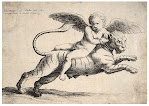
Pallas and the Centaur, Sandro Botticelli, 1482.

Thursday, March 6, 2008

"...the world has become a museum"


Then wind cheered like a hero in the tackle of the standing ships
And hurled them bravely on the swords and lances of the wintry sea—
While wisdom turned to salt upon the broken piers.

This is the way the ministers have killed the truth,
our daughter,
Steps lead back into the rooms we fear to enter;
Our minds are bleaker than the hall of mirrors:

And the world has become a museum.


From Iphigenia: Politics by Thomas Merton, 1944. Read the complete poem here.
The myth of Iphigenia can be found here.

The Sacrifice of Iphigenia, Jan Havicksz. Steen, 1671 (detail). Image from Rijksmuseum.

Wednesday, March 5, 2008

Okay, it's official


I saw birdsfoot violets in bloom during my walk this morning.


And the bluebirds are courting.


It's definitely spring.


Bluebird photo by John Koscinski from Black River Audubon Society.

Tuesday, March 4, 2008

It's a thin line between love and hate


Do you ever think about how much erotic feeling there is behind women's bitchiness about each other's looks? I've been thinking around the issue ever since I wrote the post last week about BBW feminism. Straight women's fascination with other women's bodies, especially when it has a negative cast, is a very curious phenomenon.

It's usually written off as envy, and that's surely a part of it, but envy doesn't explain why women will attack--viciously--other women who are older or less attractive, and clearly no threat to them. When I was in college it wasn't unusual to hear cruel remarks from students about female professors' lack of allure--and this was at a women's college that prided itself on its feminist values! Some of that was the natural tendency to cut down an authority figure, but there was definitely a charged gender element behind it as well. Of course, the flip side happens, too. I hear women my age and older make catty insults about young girls, and it always seems bizarre. Surely those of us in late middle age aren't competing in the same sexual arena as teenagers. If we are, somebody probably needs to call the police, or a good therapist. (For the record, I won't say I've never been guilty of ragging on another woman's looks, but my unkindness usually takes other forms.)

No, I think there's something a lot more powerful than envy going on. I think it's desire--or rather, the fear of desire. It's always seemed to me that the straight women who are least able to acknowledge their sexual feelings for other women are harshest in their judgments. They're the female version of the hypermasculine man, defending their own tender psyches from any lurking suspicion of homo tendencies. That natural erotic interest we feel, at least to some small degree, in everybody around us scares some people to death, especially when it locks in on an unacceptable target.

In fairness, libidinal attachment to unlikely people can be surprising and unsettling, even if you aren't hung up about the issue. Or think you aren't. There's a woman I see out running occasionally who's just a little younger than me, but she has a body most 20-year-olds would covet. She's tall and slender, with the most incredible legs I have ever seen. I don't know her at all, but I've always been very aware of admiring her looks, and envying her a little. I wouldn't have said I was attracted to her, though I certainly get my share of girl crushes. I saw her on a recent warm day, in shorts for the first time in months, and I immediately noticed that she was ever-so-slightly less toned than usual. Maybe she was having a bloat day, maybe she'd put on a half pound of winter weight, maybe I was imagining things. In any case, she looked marginally less perfect to me. As soon as I realized I was evaluating her body, I also became aware that I felt disappointed. In other words, I was reacting exactly like a lover, or would-be lover. It kinda shocked me, because, as I said, I wasn't aware of having a thing for her. It just crept up on me. Now, I'm okay with having a thing for her (lord knows what she would think about it), but if I were the type that isn't okay girls pairing up, I can see how I might react with hostility, even cruelty.

Anyway, it's all just something to keep in mind the next time you hear a bitchfest about a botoxed face or sagging breasts.


Jupiter and Callisto, Peter Paul Rubens, 1613. Image from Web Gallery of Art.

Monday, March 3, 2008

Downies everywhere


There's a thunderstorm blowing in right now, but the weather here was beautiful today--sunny and about 70 degrees. It's definitely spring. Not much is blooming yet, except for the daffodils, but all the critters are out and about. I even saw a bullfrog poking his head up beside the pond.

The birds all seem to be courting, especially the downy woodpeckers. We always have plenty of them around here, but there are scads of them this year. It's odd how bird populations seem to cycle. One year there'll be a glut of, say, bluejays, the next it's wrens, then thrashers, and so on. I can often pinpoint a cause for the shifts that happen around my house. For instance, we've lost most of our owls and pileated woodpeckers because a nearby housing development took out a lot of old trees. On the other hand, our thrasher population has rebounded because the feral cat population has declined, which is mostly thanks to the coyotes.

Anyway, this seems to be the year of the downy woodpecker, especially in two of the parks where I walk. I've seen one pair after another the past few days. Downy males are famously unchivalrous. They'll often chase their own mates away from a food source, but during the spring honeymoon period that competitiveness is put aside, and you'll see males and females happily feeding close together. They'll creep along a tree within inches of each other, looking like little tuxedoed mice--it's very cute.

All woodpeckers are marvels of biological engineering, but the downy seems particularly impressive. It's so tiny, just about 6 inches long, and has a small beak, but it still manages to harvest its food from the same trees where big pileateds feed. Chalotte Hilton Green has a great description of how they do it in her book, Birds of the South**, in a passage headed (no kidding), "Tongue a Marvelous Mechanism."

"It would seem almost impossible for the downy to get the grub out of this small hole, but he can extend his long tongue far beyond the beak, and its tip is hard and thorny and covered with short, backward-slanting hooks acting like a spear, which, when thrust into the grub, pulls it out easily. The slender bones that support this long tongue slide in a muscular sheath that extends around the back of the head and over the crown. Apparently ... it is the contraction of these muscles which pushes the bones down and forward."[181]

I don't have much interest in grubs, but just once I'd like to fish an olive out of a martini that way.


**(University of North Carolina Press, 1933, 1995)


Photo from Wikipedia