Sunday, June 26, 2011
"Our hearts are a sea..."
Our hearts are a sea, a lake,
Finally a little pond, where
Spider webs interlock over the round leaves,
And below them our longing
Is only a single drop of dew.
From "Written in the Sunset" by Hsiung Hung, trans. by Kenneth Rexroth.
Pond at Sunset, Fyodor Vasilyev, 1871
Thursday, June 23, 2011
"giving all the universe"
As men give vast lands to little papers with line and color, I have imagined more on the surface of your body, giving all the universe in this model....
From "A Love Letter" by Russell Edson
Hishikawa Moronobu (1618-1694)
Wednesday, June 22, 2011
Edith Wharton and other fools for love (myself included)
First, some sublime words on erotic escape, from Wharton's 1909 poem "Terminus" --
And thus some woman like me, waking alone before dawn,
While her lover slept, as I woke & heard the calm stir of your breathing,
Some woman has heard as I heard the farewell shriek of the trains
Crying good-bye to the city & staggering out into darkness,
And shaken at heart has thought: "So must we forth in the darkness,
Sped down the fixed rail of habit by the hand of implacable fate–
So shall we issue to life, & the rain, & the dull dark dawning;
You to the wide flare of cities, with windy garlands and shouting,
Carrying to populous places the freight of holiday throngs;
I, by waste lands, & stretches of low-skied marsh
To a harbourless wind-bitten shore, where a dull town moulders & shrinks...
You can read the rest of the poem here.
* * * * * * * * * * * * * * * * * * * * * * * * * * * * * * * * * * * * * * * * * * * *
These are some less sublime words from Wharton, taken from one of her letters to Morton Fullerton. They are consolation to anyone who has ever drunk dialed, or otherwise been pitiful in the grasp of unrequited love:
I never expected to tell you this; but under the weight of this silence I don't know what to say or leave unsaid. After nearly a month my frank tender of friendship remains unanswered. If that was not what you wished, what is then your feeling for me? My reason rejects the idea that a man like you, who has felt a warm sympathy for a woman like me, can suddenly, from one day to another; without any act or word on her part, lose even a friendly regard for her, & discard the mere outward signs of consideration by which friendship speaks. And so I am almost driven to conclude that your silence has another meaning, which I have not guessed. If any feeling subsists under it, may these words reach it, & tell you what I felt in silence when we were together!
You will find the rest of the letter here.
Nothing can quite top Wharton, but I'm posting so rarely these days I feel I should give you your money's worth when I do show up, so here are a few more variations on the theme:
There's a wonderful piece in Guernica on Pauline Réage/Dominique Aury, the author of The Story of O. The article is an excerpt from Nom de Plume: A (Secret) History of Pseudonyms, by Carmela Ciuraru. The discussion of the novel is skippable if you have read it, but the examination of Aury's relationship with Jean Paulhan is pretty interesting. "She wrote the book to entice him, claim him, and keep him—and she wrote it exclusively for him. It was the ultimate love letter."
In case you missed it, here's a slide show at The Daily Beast of e.e. cummings' erotic drawings, along with snippets of his love poems.
Finally -- because what's a blog without a little shameless self-promotion? -- here's a new essay by me about how some things survive our loving foolishness.
Evening, Anders Zorn, 1892 (Many thanks to Jon, an erudite friend of the blog, for providing the proper title and date of this gorgeous painting.)
Monday, May 9, 2011
Lost
Since I got to Glasgow, I’ve been stopped at least twice a day by people needing directions. I barely know this city, so only once or twice have I been able to help at all. I just smile and say sorry, I’m new here, too. They smile and go on their uncertain way. I don’t mind these little encounters, but I am always tempted to return their question with mine: Why, on a busy street with scores of people passing by, did you decide to stop me?
As long as I’ve been old enough to wander around the world by myself, I’ve been a magnet for people who have lost their way. It doesn’t matter if I’m rambling around my home turf or thousands of miles away in a completely unfamiliar city – I’ll be the person who’s asked for help. I’ve always found this baffling, since I don’t exactly stand out in a crowd. I’m an average-sized, quietly dressed woman. I’d like to think it has something to do with looking exceptionally intelligent, but I suspect it has more to do with looking exceptionally harmless; also, aimless. I am an ambler by nature. Even when I have destination and an arrival time in mind, I tend to walk pretty slowly and let the things around me catch my eye. No doubt that makes me seem more approachable than the majority of people, charging along as if they were off to battle.
Ironically, I don’t often ask for directions myself. Unless I’m late for a job interview or some other important rendezvous, I actually like getting lost. There’s a wonderful little thrill in the moment when I realize that I don’t know where I am, and have no idea how to make my way back to familiar ground. It’s liberating, and creates a feeling of being wide-awake to the environment. Suddenly, I have to pay attention instead of cruising around on autopilot. Sometimes I deliberately seek the experience, in the spirit of the dérive – a concept that, if anything, has become even more subversive in our increasingly virtual world.
A strong song tows
us, long earsick.
Blind, we follow
rain slant, spray flick
to fields we do not know.
From "Coda" by Basil Bunting
Wikipedia on the dérive
A Parisian Street Scene with Sacre Coeur in the distance, Luigi Loir (1845-1916)
Wednesday, May 4, 2011
"The trout leaps up from the water"
The trout leaps up from the water,
and if there is sun you see
the briefest shiver of gold,
and then the river again.
When the trout dies
it turns its white belly
to the mirror of the sky.
From "Damselfly, Trout, Heron" by John Engels
A Trout Rising, Joseph Crawhall (1861-1913)
Monday, May 2, 2011
The Color of Night, among other things
I am a little shocked to see that it has been almost a month since my last post. In spite of my good intentions I seem to keep wandering away from the blog. I've been literally wandering, in fact, which is one of the reasons I've neglected BitterGrace Notes. At the moment, I'm sitting in a nice little hotel in Glasgow, not far from Kelvingrove. Glasgow is beautiful now, sunny and reasonably warm, flowers in bloom everywhere--quite different from my last visit in gloomy, cold December. This is a great city in any season, though. Since I arrived last week, there have been two great global media frenzies (the Will & Kate nuptials and the assassination of Osama bin Laden), both of which seem to have left Glaswegians completely unmoved. I love that.
Before I hopped across the Atlantic, I spent a few days in Chattanooga, covering the Conference on Southern Literature for Chapter 16. (My posts are here, here and here.) It's a great conference, very small and friendly, and features members of the Fellowship of Southern Writers. Wendell Berry, Allan Gurganus, Dorothy Allison, Ann Patchett and Natasha Trethewey were just a few of the names on the line-up. It's held every 2 years, and any Southern lit fan should attend at least once. Mark your calendars for 2013.
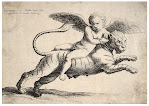
The panther-wielding maenad who adorns this post is there in honor of a new novel by one of the writers featured at the conference, Madison Smartt Bell. I interviewed Bell about The Color of Night back in February, and now that the book's out I've written a review. (You gotta read at least one to find out what maenads have to do with it.) I can't recommend Bell's brilliant little book highly enough. It'll scare you and make you think, not necessarily in that order.
Furious maenad, 490-480 BCE
Friday, April 8, 2011
"You glow like a perfumed lamp"
You glow like a perfumed lamp
In the gathering shadows.
We play wine games
And recite each other's poems.
Then you sing `Remembering South of the River'
With its heart breaking verses. Then
We paint each other's beautiful eyebrows.
I want to possess you completely -
Your jade body
And your promised heart.
It is Spring.
Vast mists cover the Five Lakes.
My dear, let me buy a red painted boat
And carry you away.
From "For the Courtesan Ch'ing Lin" by Wu Tsao, trans. by Kenneth Rexroth and Ling Chung. Read the rest of the poem here. You will find a brief commentary on the poem here.
Zwei Mädchen mit Tulpe, Dorothea Maetzel-Johannsen, 1921
Thursday, April 7, 2011
"large, brilliantly beautiful, fat"
"She was fat the first time we saw her, large, brilliantly beautiful, fat. She seemed for this moment that never again returned to be almost a matron, someone real and sensible who carried money to the bank, signed papers, had curtains made to match, dresses hung and shoes in pairs, gold and silver, black and white, ready. What a strange, betraying apparition that was, madness, because never was any woman less a wife or mother, less attached; not even a daughter could she easily appear to be. Little called to mind the pitiful sweetness of a young girl. No, she was glittering, somber, and solitary, although of course never alone, never. Stately, sinister, and absolutely determined."
Elizabeth Hardwick on Bille Holiday, in The New York Review of Books
Tuesday, April 5, 2011
"Let a joy keep you"
Joy
Carl Sandburg
Let a joy keep you.
Reach out your hands
And take it when it runs by,
As the Apache dancer
Clutches his woman.
I have seen them
Live long and laugh loud,
Sent on singing, singing,
Smashed to the heart
Under the ribs
With a terrible love.
Joy always,
Joy everywhere—
Let joy kill you!
Keep away from the little deaths.
Text from Bartleby.com
Two Boeotian Girls (costume sketch for the ballet Narcisse), Leon Bakst, 1911
Friday, April 1, 2011
Joyce Carol Oates, Richard Bausch, et al.
I just realized that I have a couple of recent interviews up at Chapter 16 that I’ve failed to mention here – one with Joyce Carol Oates, and another with Richard Bausch. Bausch has some interesting things to say about the writing process and the "Southern writer" issue, and Oates discusses her new memoir. You’ll find lots of other good recent stuff on the site, including an essay by Amy Greene (author of Bloodroot), and interviews with Bobbie Ann Mason, Yann Martel and Tom Perrotta. Please click here to see it all.
By the way, when I say please click, I mean PLEASE click. Chapter 16 is a non-profit that relies on grants and donors to keep going (and pay writers). The folks who shell out the money like to see evidence of readers, so think of every click as a vote against the guillotine for our little project. We thank you.
Beggars at the Door, Rembrandt, 1648
Subscribe to:
Posts (Atom)