When most I wink, then do mine eyes best see,
For all the day they view things unrespected;
But when I sleep, in dreams they look on thee,
And, darkly bright, are bright in dark directed.
Then thou, whose shadow shadows doth make bright,
How would thy shadow's form form happy show
To the clear day with thy much clearer light,
When to unseeing eyes thy shade shines so!
How would, I say, mine eyes be blessed made
By looking on thee in the living day,
When in dead night thy fair imperfect shade
Through heavy sleep on sightless eyes doth stay!
All days are nights to see till I see thee,
And nights bright days when dreams do show thee me.
Shakespeare, Sonnet 43
1. Liebespaar, Otto Mueller, c.1920
2. Bathers at San Niccolò (detail), Passignano, 1600
3. [Title unknown], Koloman Moser, c.1915
4. Femme nu, Ernest Laurent, 1915
5. Pompeiian fresco
6. Two girls - Lovers, Egon Schiele, 1911
7. Sketch, Carl Olof Larsson, 1914
8. Study for Kneeling Leda, Leonardo da Vinci, c.1505
9. Male nude reclining, Maurycy Trębacz, 1887
10. Male nude, William Etty, c.1820-1830
11. Male couple, Suzuki Harunobu, c.1750
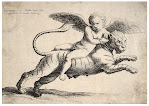
12. Satyr mason, after Agostino Carracci, 16th century
13. Mujeres indolentes, Alfredo Guttero, 1927
Sunday, February 12, 2012
Wednesday, February 8, 2012
"Each day with so much ceremony begins"
Anaphora
by Elizabeth Bishop
Each day with so much ceremony
begins, with birds, with bells,
with whistles from a factory;
such white-gold skies our eyes
first open on, such brilliant walls
that for a moment we wonder
"Where is the music coming from, the energy?
The day was meant for what ineffable creature
we must have missed?" Oh promptly he
appears and takes his earthly nature
instantly, instantly falls
victim of long intrigue,
assuming memory and mortal
mortal fatigue.
More slowly falling into sight
and showering into stippled faces,
darkening, condensing all his light;
in spite of all the dreaming
squandered upon him with that look,
suffers our uses and abuses,
sinks through the drift of bodies,
sinks through the drift of classes
to evening to the beggar in the park
who, weary, without lamp or book
prepares stupendous studies:
the fiery event
of every day in endless
endless assent.
Today is the birthday of Elizabeth Bishop (1911-1979). A recent article on her by William Logan is here, and you'll find her Paris Review interview here.
Alpleben, Ernst Ludwig Kirchner (1880-1938)
Sunday, February 5, 2012
"The man or woman outside has a word for you"
O rarely will the thing you most
need rise to your hand.
O rarely will your love come to
you on your darkest day
with the precise counter-spell. O,
friend, why do you sit
and wait for the bell? Rise now
and open the drapes. The
man or woman outside has a
word for you. ...(more)
From "Walking on God's Good Side" by Corey Mesler. Complete poem at Curio Poetry.
Sunrise in the Catskill Mountains, Thomas Cole, 1826
Wednesday, February 1, 2012
"the alchemy of four stomachs"
Not milk, not cream,
not even crème de la crème.
It was a delicacy which assured me
that bliss follows agitation,
that even pasture daisies
through the alchemy of four stomachs
may grace a king's table.
From "Butter" by Connie Wanek
Woman Milking a Red Cow, Karel Dujardin, c.1650
Wishing you all the blessings of Imbolc
"From darkness grows a gaudy revelation"
We share the cycle of flower, grapeleaf, fruit.
They don't speak just the language of the seasons.
From darkness grows a gaudy revelation
which is perhaps the object of some mute
envy from the dead, who strengthen the soil.
Can we conceive how they regard their part
in this? It long has been their way to lard
the loam through with their marrow. But this toil:
the question seems to be, whether this is
done freely. Does this, heavy work of slaves,
ensphered press up to us, their lords, as fruit?
Or are they the lords, who sleep beside the roots,
and grant us out of their affluent graves
this thing halfway between brute force and kisses?
From Sonnets to Orpheus by Rainer Maria Rilke, trans. by Howard A. Landman
Im Garten von Schloß Pretzfeld, Curt Herrmann, c.1903
Saturday, January 28, 2012
"the true, desired form of you"
Grizzled and white the old man leaves
the sweet place, where he has provided for his life,
and leaves the little family, filled with dismay
that sees its dear father failing it:
then, from there, dragging his aged limbs
through the last days of his life,
aiding himself by what strength of will he can,
broken by years, and wearied by the road:
he reaches Rome, following his desire,
to gaze on the image of Him
whom he hopes to see again in heaven:
so, alas, I sometimes go searching,
lady, as far as is possible, in others
for the true, desired form of you.
Petrarch, from the Canzoniere, translated by A.S. Kline.
Female Nude with Blue Cloth, Koloman Moser, c.1013
Wednesday, January 25, 2012
"The Fantastic Flying Books of Mr. Morris Lessmore"
Fifteen completely delightful minutes long:
The Fantastic Flying Books of Mr. Morris Lessmore from Moonbot Studios on Vimeo.
Monday, January 23, 2012
"Whole and alive, like an untorn language"
What explains poetry is that life is hard
But better than the alternatives,
The no and the nothing. Look at this light
And color, a splash of brilliant yellow
Punctuating an emerald text, white swans
And mottled brown ducks floating quietly along
Whole and alive, like an untorn language
That lacks nothing, that excludes
Nothing. Period. Don’t you think
It is our business to defend it
Even the day our masters start a war?
To defend the day we see the daffodils?
From "Daffodils" by Alicia Ostriker. The complete poem is here.
I recently did a Q&A with Ostriker for Chapter 16. She's a brilliant writer, with interesting things to say about religion, poetry and politics. You can read the interview here.
Photo by BitterGrace. Share freely.
Saturday, January 21, 2012
To Osip Mandelstam
Where did this feeling come from?
…They”re not the first, these curls
I’ve caressed, and I’ve kissed
Lips darker than yours.
Stars have flared and died
(Where did this feeling come from?)
And eyes as well, flared and died
Before my very eyes.
And often in the dead of night
I’ve heard more wonderful songs
(Where did this feeling come from?)
Lying in a singer’s arms.
Where did this feeling come from?
What shall I do with it, singer
Who just stopped by, pretty boy
With the bedroom eyes.
"To Osip Mandelstam" by Marina Tsvetaeva, from The Stray Dog Cabaret: A Book of Russian Poems, translated by Paul Schmidt.
*With thanks to Howard, a wise and delightful friend of the blog.
Liebespaar, Koloman Moser, c.1913
Friday, January 20, 2012
"He's such a quiet little chap"
I love my little Teddy Bear,
He's such a friendly fellow,
His fur, beautiful and soft,
Is neither brown or yellow.
He plays but never quarrels with me,
And keeps me gay and jolly,
And I don't have to punish him
As often as my Dolly.
He's such a quiet little chap,
No impish schemes he hatches,
He never barks, he has no fleas,
At least he never scratches.
"Bears" by Eula Smith-Zimmerman
Illus. by Raphael Kirchner (1876-1917)
Subscribe to:
Posts (Atom)


.jpg)


,_nr_240.jpg)