At one of the parks where I walk there are bluebirds that hang out year-round in the woods at the edge of the parking lot. There's a single nest box there, but I often see as many as three couples sharing the area. It must be a good feeding spot. They were all out this morning, and I stopped to watch them on my way back to my car. ...(more)
...and the woman-hating Religious Right is in at least partial eclipse, I'm feeling a little better about the prospects for women's rights in this country. Obama's signing of the Lilly Ledbetter Fair Pay Act, and lifting the Mexico City gag rule within days of taking office--hey, that's more than W did for us in 8 years. (Actually, I think it might also be more than Clinton did for us, though perhaps my memory fails me.) But while we gain even more equality, life remains difficult for many of our sisters around the world. I never want to forget their suffering, or the good, brave people who work to help them.
Democracy Now! had an interview this morning with Eve Ensler and Dr. Denis Mukwege, the Congolese gynecologist who has made it his mission to treat the women who have been raped and brutalized during the war in DRC. You can see the clip here. The cruelty of the Congo war is horrifying, but Mukwege's work is proof that the best part of humanity can defy the worst.
Since Obama is determined to escalate the war in Afghanistan, I think we should remember that the situation for most women there has not changed much since the removal of the Taliban. For information about the real condition of Afghan women, visit the website of the ferocious Revolutionary Association of the Women of Afghanistan (RAWA). It's especially enlightening to read the articles at their news page, which will give you some idea of the violence and repression Afghan women routinely face. You can read a little more about the organization here, and at the group's Wikipedia page. I wish I had a fraction of the courage they possess.
They Carried Her Off, Francisco de Goya y Lucientes, 1797-98.
The wild winds weep And the night is a-cold; Come hither, Sleep, And my griefs infold: But lo! the morning peeps Over the eastern steeps, And the rustling birds of dawn The earth do scorn.
Lo! to the vault Of paved heaven, With sorrow fraught My notes are driven: They strike the ear of night, Make weep the eyes of day; They make mad the roaring winds, And with tempests play.
Like a fiend in a cloud, With howling woe, After night I do crowd, And with night will go; I turn my back to the east, From whence comforts have increas'd; For light doth seize my brain With frantic pain.
From Blake's Poetical Sketches, 1783.
Moonlight, Wolf, by Frederic Remington. c. 1909. Image from Artcyclopedia
(Okay, so this is not the best poem for battling the Monday blues. It was just irresistible to me, as was the painting. Come back later in the week for a Madini review--and yes, finally, Temple Grandin.)
I have a favorite shortcut in west Nashville, a winding little road nestled between a pair of steep ridges. There are apartment complexes on one side of the road but the other side is heavily wooded. It’s always a nice route to take, especially in the summer when the trees provide pretty, dappled shade. I’ve often driven along there and thought about all the living things that have found sanctuary in the woods, a place of safety away from the highways and vast expanses of concrete. ...(more)
If you asked me to name just one perfume to lift a dark mood, it would be Madini Azahar. This simple orange blossom fragrance is good cheer in a bottle, and it won't leave a hangover in its wake. In fact, one of the nicest things about Azahar is its slow, smooth fade. Unlike many of its natural sisters*, it doesn't disappear in seconds, nor does it slide into the nasty metal-and-vinegar stink that seems to be the trade-off for the greater lasting power of synthetics.
Azahar lacks the high-pitched clarity of that queen of all orange blossom soliflores, Serge Lutens' Fleurs d'Oranger; but it compensates with a depth the Lutens scent lacks. Fleurs d'Oranger has the kinetic joy of a honeybee buzzing from flower to flower; Azahar suggests the bee's ecstasy as it settles into the blossom's embrace. Azahar's quieter presence lets you enjoy its sunny sweetness even in midwinter, without feeling that you're screaming out your discontent with the season.
Perhaps it's a little crass to mention money in a random rave, but with Azahar affordability is part of the pleasure. You can get a 3ml roll-on bottle--which will last a long time--for well under $20. Tigerflag Natural Perfumery carries Azahar and a nice assortment of other Madinis. A complete selection can be found at Talisman. I've had excellent service from both, but Tigerflag usually has faster shipping and tucks in some free samples.
*The Madini perfumes are supposed to be naturally sourced. I have no idea whether Azahar is in fact birthed from real flowers, but it certainly smells true to Mother Nature. See the post at Tigerflag's blog for further discussion of the issue.
Orange Blossom painting by Mary E. Eaton, from National Geographic Magazine, June 1917. Image from Wikimedia Commons.
If you're checking back for the Temple Grandin post, I swear it's coming--Friday, probably. Meanwhile, I'd like to talk about woodpeckers; specifically, the quartet of pileated woodpeckers I watched in the park on Sunday. Their courtship season is underway, so the woods are filled with the sound of territorial drumming. There's plenty of calling and chasing, too, inspired by anger as well as desire. Pileateds, like most woodpeckers, are very contentious when they're mating and nesting. ...(more)
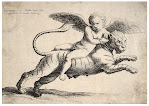
...so I thought I'd just do a little picture post of images that caught my fancy.
Here we have yet another Leda and the Swan, this one by Hans Baldung Grien (1480-1545), who has probably gotten more space on this blog than any other artist. (I wonder if I should be embarraassed by that.)
Staying with mythological themes, here is The Rape of Europa as depicted by Jan-Erasmus Quellinus (1607-1678). I've been on the hunt for nice cattle paintings since I put up that pretty cow for Imbolc. I'm amazed at the number of artists who seemed to do little but paint cows. Who knew?
Someone please explain to me what was up with Félicien Rops (1833-1898). His work is fascinating, but so deeply weird that I am a little worried about how much I like it.
I've been eager to see Waltz with Bashir since I heard about it last year, and it finally arrived in Nashville this week. Dave and I saw it Saturday night, and I've been racking my brain ever since, trying to think up something to say about it that isn't hopelessly cliched. "Powerful," "moving," "harrowing"--this film is all those things, but of course people say the same about every great war movie. I need words you haven't read a hundred times before, words that will grab your attention, because Waltz with Bashir is a film I honestly believe everyone ought to see.
The story is based on the experiences of the director, Ari Folman, who served with the Israeli army during the war in Lebanon in 1982. In the film, the character of Ari is haunted by his inability to remember the war, particularly the massacre of Palestinians at the Sabra and Shatila refugee camps, which was carried out by Christian Phalangists with the complicity of the Israelis. (There is a brief account of the war and the massacre at the film's website--click on the link for "The 1982 Lebanon War." You can also read Robert Fisk's account of entering the camps after the killings here.)
Ari seeks out and questions his old comrades from the war, trying to find the key that will awaken his memory. The film shifts continually from past to present, and from Ari's dreams and piecemeal recollections to his fellow soldiers' stories. The whole film has the feel of an extended nightmare, where even peaceful moments are surreal, and confusion alternates with horror. The audience feels the terrible tension that Ari feels, wanting to know the truth yet dreading it. In the end, the audience confronts reality at the moment Ari does, and even for viewers who know the history of what happened, it's an almost overwhelming moment of shock and disgust.
There's nothing polemical about the film. It doesn't set out to make an antiwar argument, nor does plead a case for any of the participants in the incident. Ari's story is presented in entirely personal terms, and that's what makes this such an extraordinary and valuable film. It's set within a seemingly interminable, complex conflict, but by focusing on the individual story of Ari--a character who does not fit neatly into the category of victim or villain--the film transcends the playground morality of war rhetoric, and just shows us what war is, and what it does to the human beings on every side. I don't see how anyone could ever entertain the idea of a "just war" after seeing Waltz with Bashir.
This trailer doesn't really do the film justice, but it will give you some idea of how beautifully it is made. The music is phenomenal.
I could sense the Wheel turning as I walked this morning. The light of the rising sun had a new brightness and warmth, and there was a sweet breeze blowing. All the birds were courting like crazy.
Imbolc is often honored with foods containing milk, since this is the time of year when new life begins to arrive. Celtic tradition calls for sheep's milk, but since that's a little hard for most of us to come by, cow's milk will do. The pretty girl above is a White Park cow, the breed supposedly kept by the Druids. You can read a little more about them at WhitePark.org, where I found the illustration. Click around the site for more nice images of the breed.


.jpg)



.jpg)